Operations
Welcome to the Grand Ledge Public Schools Operations Department is made up of our Maintenance, Grounds and Custodial Teams. This team is committed to the district's mission: “To provide safe, clean, healthy and comfortable learning environments that are flexible, efficiently operated to support learning, district programs and services”.
Department Programs include:
- Custodial Cleaning
- Facility Maintenance
- Grounds Care
- District Warehouse & Courier
- Fleet Maintenance
- Health, Safety & Environmental Programs
AHERA Notification

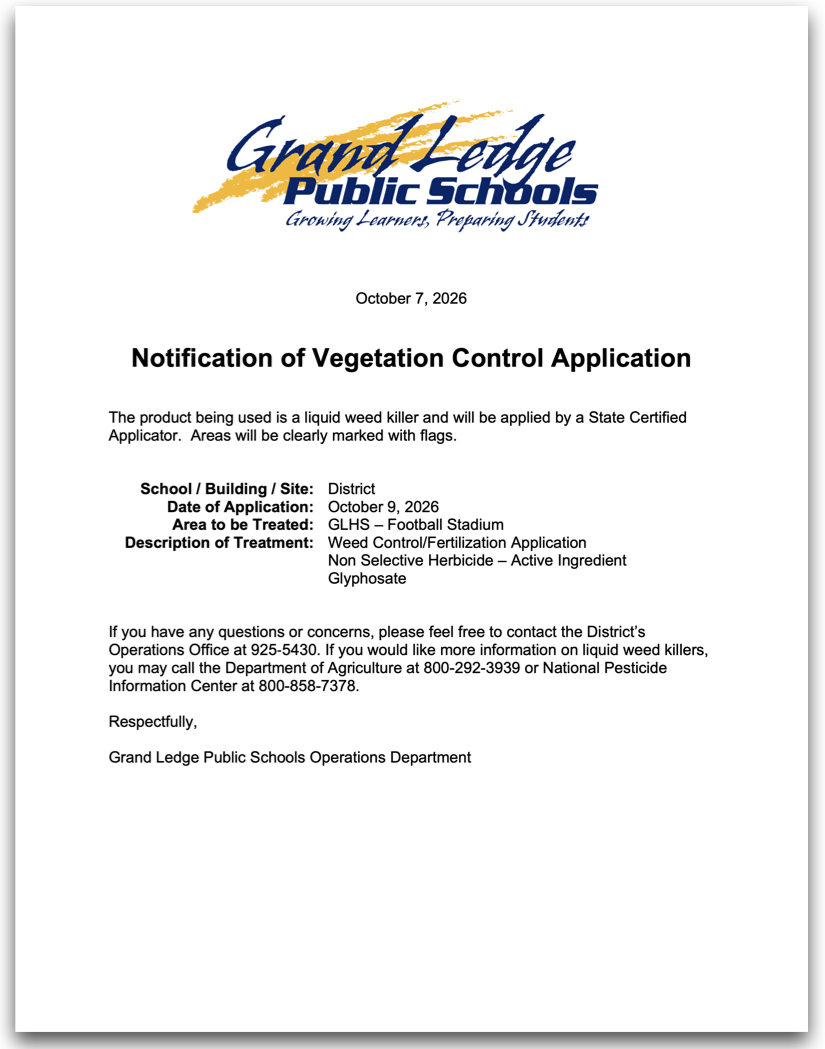
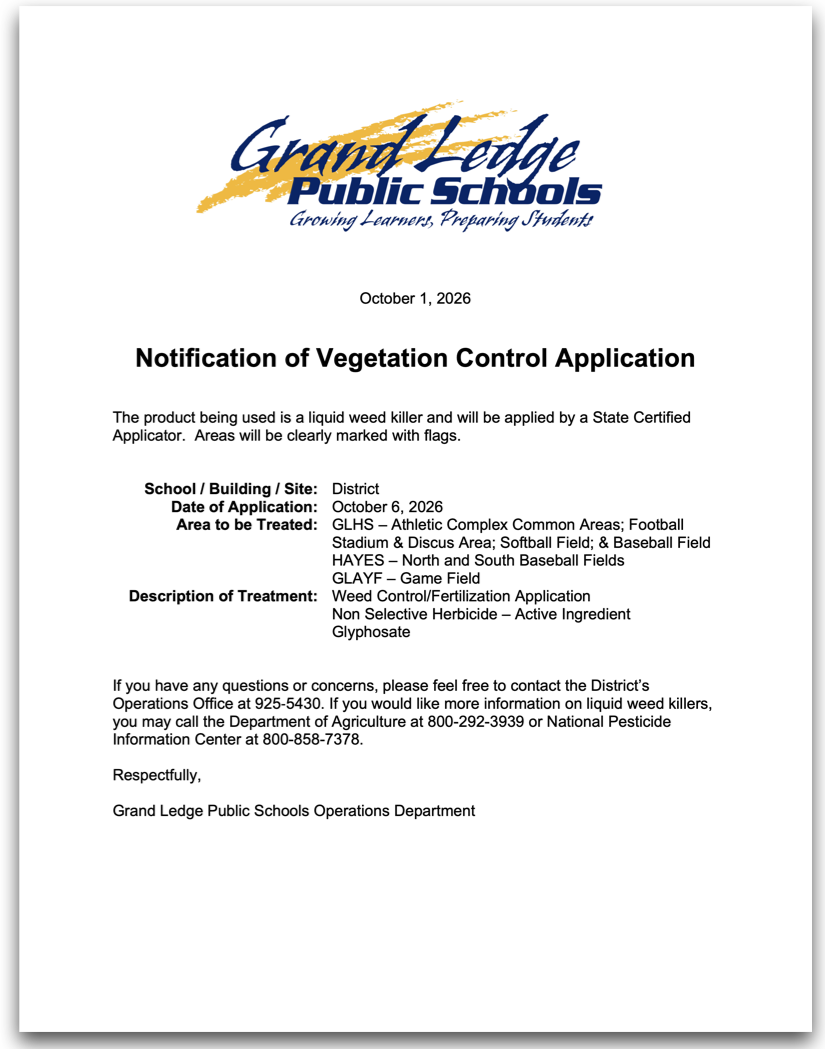
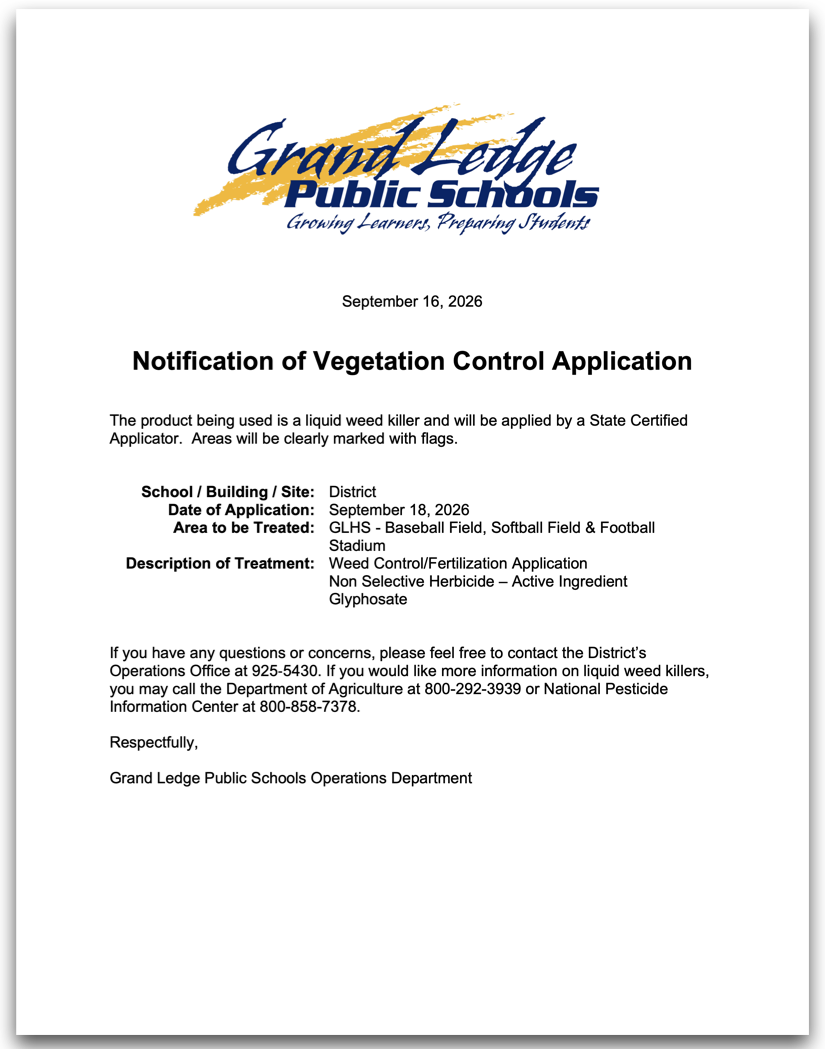
Application Notifications


Hazardous Communications Program
Written Hazard Communication Program
Grand Ledge Public Schools
Effective: March 14, 2024
General
The following hazard communication program has been established for Grand Ledge Public Schools. This program will be available for review by all employees.
Hazard Classification
Chemical manufacturers or importers shall evaluate chemicals they produced or import to classify the chemicals in accordance with the revised Hazard Communication Standard.
Effective June 1, 2015 - For each chemical, the chemical manufacturer or importer shall determine the hazard classes, and where appropriate, the category of each class that apply to the chemical being classified. This information will be placed in the Safety Data Sheet (SDS) and on the product label.
Grand Ledge Public Schools will rely on SDSs obtained from product suppliers to determine which chemicals are classified as hazardous for employees.
Labeling
- The Operations Supervisor will be responsible for seeing that all containers entering the workplace from a manufacturer, importer or distributer are properly labeled.
- All labels shall be checked for:
- Product identifier;
- Signal word;
- Hazard statement(s);
- Pictogram(s);
- Precautionary statement(s); and,
- Name, address, and telephone number of the chemical manufacturer, importer, or other responsible party.
- Each employee shall be responsible for ensuring that all secondary workplace containers used in their work area are labeled with the appropriate product identifier and provide employees with information regarding the physical and health hazards of the hazardous chemical.
Note: Workplace labeling. The employer shall ensure that each container of hazardous chemicals in the workplace is labeled, tagged or marked with either:
The information specified for labels on shipped containers; OR, product identifier and words, pictures, symbols, or combination thereof, which provide at least general information regarding the hazards of the chemicals, and which, in conjunction with the other information immediately available to employees under the hazard communication program, will provide employees with the specific information regarding the physical and health hazards of the hazardous chemical.
Safety Data Sheets
Change from MSDS to SDS format effective June 1, 2015 - Chemical manufacturers or importers shall ensure that SDSs for their products includes the following Sections in order:
- Section 1, Identification;
- Section 2, Hazard(s) identification;
- Section 3, Composition/information on ingredients;
- Section 4, First-aid measures;
- Section 5, Fire-fighting measures;
- Section 6, Accidental release measures;
- Section 7, Handling and storage;
- Section 8, Exposure controls/personal protection;
- Section 9, Physical and chemical properties;
- Section 10, Stability and reactivity;
- Section 11, Toxicological information.
- Section 12, Ecological information;
- Section 13, Disposal considerations;
- Section 14, Transport information;
- Section 15, Regulatory information; and
- Section 16, Other information, including date of preparation or last revision.
- The Operations Supervisor will be responsible for compiling and maintaining the master SDS file. The file will be kept at Operations Building, 12730 Nixon Rd, Grand Ledge, MI.
- Additional copies of SDSs for employee use are located at https://glps-mi.newlook.safeschoolssds.com/.
- SDSs will be available for review to all employees during each work shift. Copies will be available upon request to the Operations Supervisor.
- Posters identifying the person responsible for maintaining SDSs and where the SDSs are located are posted at each GLPS building. Posters notifying employees when new or revised SDSs are received will be located in the same location(s).
- If a required SDS is not received, the Operations Supervisor shall contact the supplier, in writing, to request the SDS. If an SDS is not received after two such requests, the Operations Supervisor shall contact the MIOSHA's Construction Safety and Health Division at (517) 284-7680 or General Industry Safety and Health Division (GISHD) at (517) 284-7750, for assistance in obtaining the SDS.
The MIOSHA program does not maintain a library of SDSs. However, either of the above divisions will assist an employee in obtaining a copy of an SDS by contacting the employer or supplier.
Employee Information and Training
- The Operations Supervisor shall coordinate and maintain records of employee hazard communication training, including attendance rosters.
- Before their initial work assignment, each new employee will receive hazard communication training. This will include the following information and training:
Information:
- The requirements of the MIOSHA Hazard Communication Standard
- All operations in their work area where hazardous chemicals are present
- Location and availability of the written hazard communication program, the list of hazardous chemicals, and the SDS
Training:
- Methods and observations that can be used to detect the presence or release of hazardous chemicals in the work area;
- The physical, health, simple asphyxiation, combustible dust and pyrophoric gas hazards, as well as hazards not otherwise classified, of the chemicals in the work area;
- Measures the employees should take to protect themselves from these hazards;
- Details of the hazard communication program-- including an explanation of the new label elements [product identifier; signal word; hazard statement(s); pictogram(s); and, precautionary statement(s)] on shipped containers and the workplace labeling system used by their employer; the new SDS format/sections; and,
- How employees can obtain and use hazard information
- The employee shall be informed that:
- The employer is prohibited from discharging, or discriminating against, an employee who exercises his/her rights to obtain information regarding hazardous chemicals used in the workplace.
- As an alternative to requesting a SDS from the employer, the employee can seek assistance from the MIOSHA Construction Safety and Health Division, at (517) 284-7680, or the MIOSHA General Industry Safety and Health Division at (517) 284-7750, to obtain the desired SDS. A sign or MIOSHA poster will be posted with the address and telephone number of the MIOSHA Divisions responsible for such requests.
- Before any new physical or health hazard is introduced into the workplace, each employee who may be exposed to the substance will be given information in the same manner as during the hazard communication training.
Hazardous Non-routine Tasks
- Occasionally, employees are required to perform non-routine tasks (i.e., clean reactor vessels, enter confined spaces, etc.). Prior to starting work in such areas, each employee will be given information about the hazards of the area or procedure. This information will include:
- Specific chemical hazards.
- Protection/safety measures the employee can take to lessen risks of performing the task.
- Measures the company has taken to eliminate or control the hazard, including:
- air monitoring,
- ventilation requirements,
- use of respirators,
- use of attendants to observe procedures, and
- emergency procedures.
List of Hazardous Chemicals
A list of all hazardous chemicals used by Grand Ledge Public Schools is located at Operations Building, 12730 Nixon Rd, Grand Ledge, MI. Further information regarding any of these chemicals can be obtained by reviewing its respective SDS.
1. It is the policy of Grand Ledge Public Schools that no employee will begin performance of a non-routine task without first receiving appropriate safety and health training.
- Hazardous non-routine tasks we have at our facility include: List hazardous non-routine tasks.
Entry of Confined Spaces. Line-breaking, Hot Work.
Multi-Employer Worksites -- Informing Contractors
- If our company exposes any employee of another employer to any hazardous chemicals that we produce, use, or store, the following information will be supplied to that employer:
- The hazardous chemicals they may encounter.
- Measures their employees can take to control or eliminate exposure to the hazardous chemicals.
- The container and pipe labeling system used on-site.
- Where applicable SDSs can be reviewed or obtained.
- Periodically, our employees may potentially be exposed to hazardous chemicals brought on our site by another employer. When this occurs, we will obtain from that employer information pertaining to the types of chemicals brought on-site, and measures that should be taken to control or eliminate exposure to the chemicals.
- It is the responsibility of the Operations Supervisor to ensure that such information is provided and/or obtained prior to any services being performed by the off-site employer. To ensure that this is done the following mechanism will be followed: List all method(s) used to ensure the required information is provided or obtained.
All off-site employers will be provided with a contractor information form which provides information available to GLPS on chemicals they may be exposed to, and require them to either verify that they are not exposing employees to hazardous chemicals, or requiring submission of SDS’s and meeting with the Supervisors of Buildings and Grounds to manage any risks presented by the hazardous chemicals.
Pipes and Piping Systems
A. Information on the hazardous contents of pipes and piping systems will be identified by: List
means of identification for pipes and piping systems
- Labeling and verification by the Operations Supervisor or his designee.
Integrated Pest Management Program
Grand Ledge Public Schools has adopted an Integrated Pest Management program. Inherent with this are the district’s efforts to reduce pesticide use as much as possible. While it may occasionally be necessary to apply a pesticide, this program does not rely on routine pesticide applications to resolve problems. We use various techniques such as habitat alteration, sanitation, mechanical means, exclusion, etc. to prevent pests from becoming a problem.
As required by Michigan law, you will receive advanced notice of non-emergency application of a pesticide (insecticide, fungicide, or herbicide), other than bait or gel formulation. This advance notice of a pesticide application will be given at least 48 hours before the application by the following two methods:
(1) Posting at the primary entrance to your child’s school, the one nearest the main office, and
(2) posting on the district website at GLcomets.net/Notifications.
Please note that notification is not given for use of sanitizers, germicides, disinfectants or antimicrobial cleaners. In certain emergencies, such as an infestation of stinging insects, pesticides may be applied without prior notice to prevent injury to students, but you will be promptly notified following any such application, via the two posting methods identified above.
You may review the school’s Integrated Pest Management program and records of any pesticide application upon request by contacting the Operations Department at 517-925-5430.
Parents or guardians of children attending the school are also entitled to receive the advance notice of a pesticide application, other than a bait or gel formulation, by email at least 3 days before the application, if they so request. If you would like to be added to the advance notification email list, please contact the Operations Department at 517-925-5430 to share your name, preferred email address, and what school(s) your child or children attend.
Storm Water Management
How Does Storm Water Affect Our Environment?
One of the most significant, yet unrecognized groups of water contaminants is storm water pollutants. When it rains or snows, storm water flows over streets, lawns, fields and buildings to lower areas such as lakes, streams and wetlands. This runoff can collect debris, oil, grease, pesticides, fertilizers and other harmful chemicals that eventually make their way into our rivers, creeks or lakes. Unlike sanitary sewers that divert water to a treatment plant directly from your home, storm drains lead directly to surrounding lakes and rivers without any type of treatment. All the debris and pollutants that were picked up by storm water runoff end up in your lakes and streams!
Under the National Pollutant Discharge Elimination System (NPDES) Phase II Program, Grand Ledge Public Schools is obligated to reduce storm water pollution to the maximum extent practicable to protect water quality and comply with the Clean Water Act. Grand Ledge Public Schools' Storm Water Management Plan (SWMP) consists of six program elements:
- Public Education and Outreach -- Informing citizens of the impacts polluted stormwater runoff discharges can have on water quality.
- Public Participation/Involvement -- Providing opportunities for citizens to participate in program development and implementation.
- Illicit Discharge Detection and Elimination -- Eliminating illegal discharges to the storm sewer system, including improper disposal of waste.
- Construction Site Runoff Control -- Implementing an erosion and sediment control program during construction activities.
- Post-Construction Runoff Control -- Protecting sensitive areas (e.g., wetlands and streams) from storm water flows resulting from development.
- Pollution Prevention/Good Housekeeping -- Adopt pollution prevention and good housekeeping measures during facility operations.
Learn More & Get Involved!
Here are just a few ways YOU can help prevent storm water pollution:
- Never dump anything down a storm sewer or drain.
- Take used oil to your local quick lube or auto shop.
- Dispose of pet waste in a trash can.
- Wash your car on your lawn so excess water, chemicals and dirt are filtered through grass and vegetation.
More Information and Resources:
 Michigan Department of Environmental Quality (MDEQ) Storm Water Management
Michigan Department of Environmental Quality (MDEQ) Information & Education Publications
Michigan Water Stewardship Program
"Pollution Isn't Pretty" Campaign
Here is a list of local (Lansing-area) watershed and environmental organizations! These groups sponsor river and stream clean-up days, remove trash and invasive species, promote awareness of water quality and pollution prevention, and encourage recreational use of our local waterways.
Middle Grand River Organization of Watersheds (MGROW)
Mid Michigan Environmental Action Council (Mid-MEAC)
Friends of the Lansing Regional Trails (FLRT)
Greater Lansing Regional Committee for Stormwater Management

Maintenance Team
Grounds Team