Academic Services
Mission: Growing Learners, Preparing Students
Vision: Grand Ledge Public Schools will provide every student a high-quality education, critical thinking skills, and social development to reach their highest potential in a safe and inclusive environment.
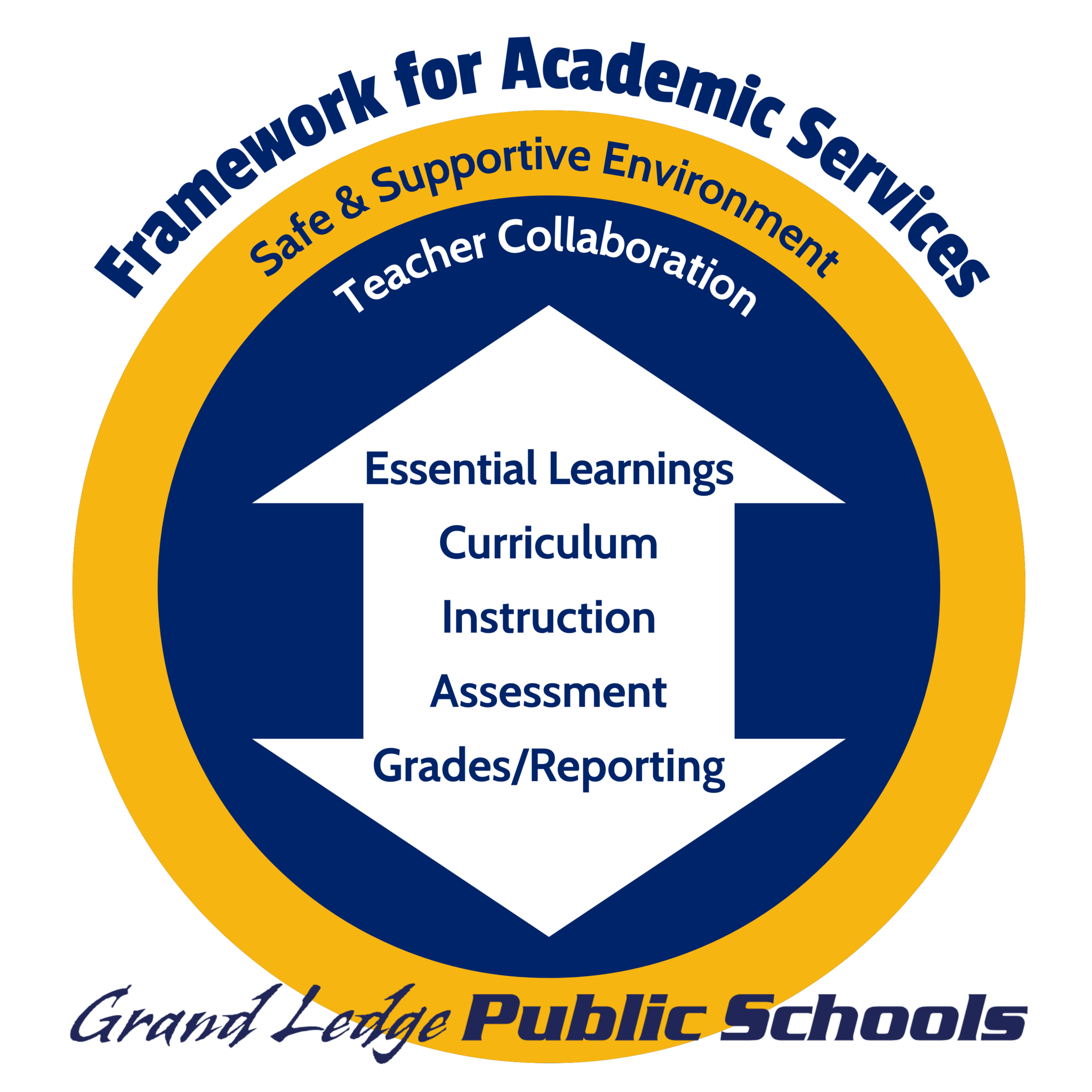
GLPS Framework for Academic Services
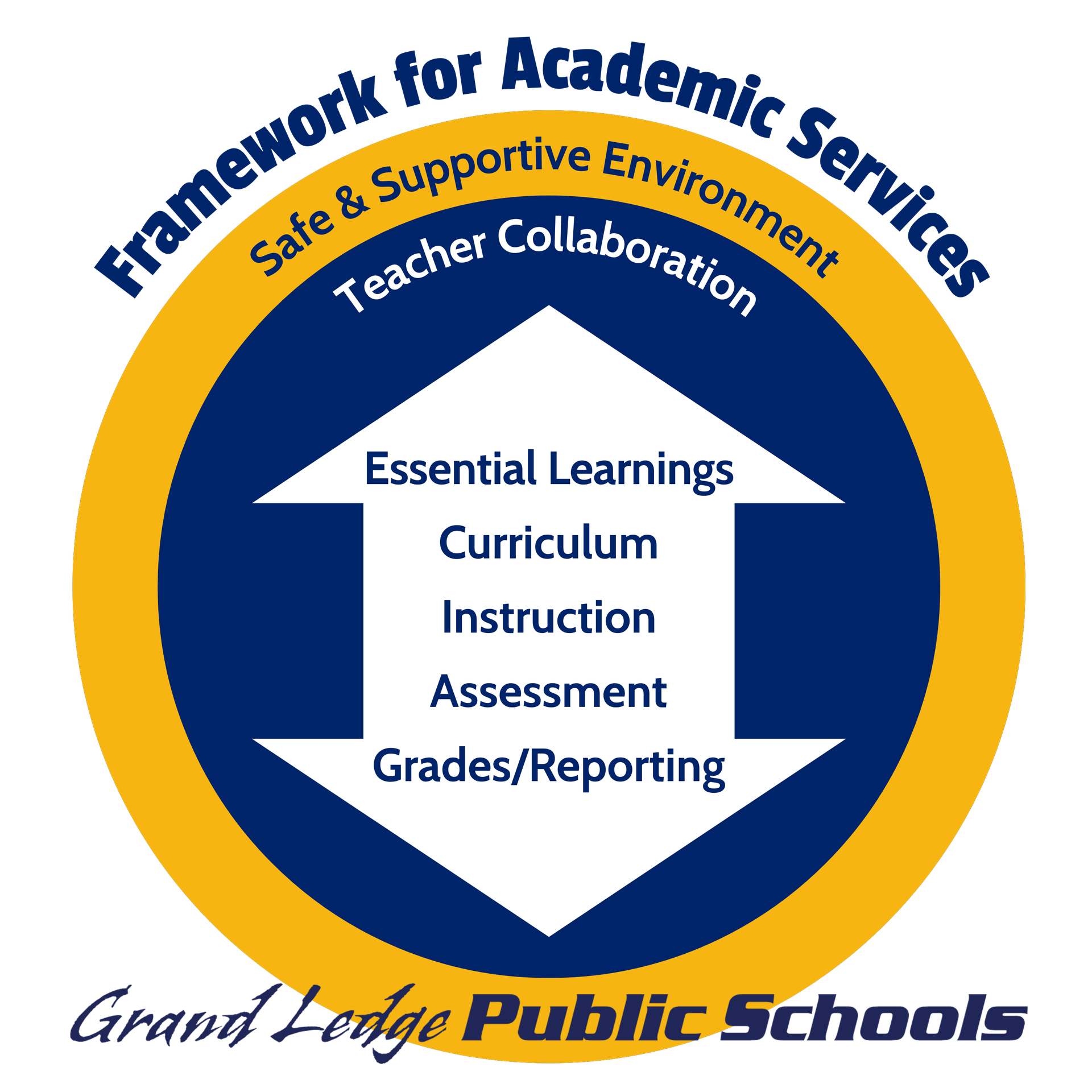
In order to meet the needs of students as 21st-century learners, it is important that we think strategically to create opportunities for their success. To those ends, our job in the Academic Services office is to ensure that the instructional program for the district is aligned to ensure success for all students. This framework, rooted in current research and best practices, is designed to guide work taking place throughout GLPS.
Outer Circles – Safe & Supportive Environment and Teacher Collaboration
These circles are informed by the Marzano High Reliability Schools framework, which lists a safe and collaborative environment as foundational to a high reliability school (level 1). They are circles outside of the instructional arrow because they create the conditions that allow all of the other elements of the school to exist and function effectively. They are the foundation for a successful school, and without them, the elements of teaching and learning cannot function on a systematic basis.
The Inner Arrow – Essential Learnings, Curriculum, Instruction, Assessment, and Grading/Reporting
The inner arrow represents the work that happens on a daily basis in the classroom, and it is rooted in the necessity of aligned systems. The arrow is double-sided, because no matter where one starts in the list, the system should be aligned above it and below it. For example, the curriculum must be aligned to the essential learnings and to the instruction being provided, just as the instruction should be aligned to the curriculum being taught and to the assessment being given. In an optimal system, one should be able to start anywhere on the arrow and accurately define what is happening above and below. Essential learnings are at the top of the arrow and grading/reporting are at the bottom, because the process starts with the identification of essential learnings, based on standards, and ends with reporting out on the students’ demonstrated knowledge of them. Each of the five elements has specific criteria and definitions, and understanding them is key to understanding the entire model.
Rationale for the Framework
Teaching and learning within a school are complicated endeavors. There are many factors that impact how and when a student learns, and in today’s era of accountability, educators can easily get bogged down in achievement data, state expectations, evaluations, etc., particularly if they look at each element as an individual task. If, instead, we look at the system, we can compartmentalize the work in a way that allows us to focus on the STUDENTS, not the requirements. If the work is done upfront to make sure that the systems are aligned, then a teacher can go into the classroom knowing that the day’s learning goal is supported by the curriculum and can be taught using a variety of instructional strategies. The alignment work ensures that student success in the classroom will equal student success on various assessments, and the reporting ensures that students and parents know where they stand. This framework does not define how teachers teach, it does not dictate classroom assessments, and it builds in authentic opportunities for collaboration around things outside of our control, like M-STEP or SAT. In short, it creates defined autonomy, leverages the expertise of the teachers, administrators, and staff in the buildings and in the district, and creates a roadmap for success. It allows the focus in the classroom to be on the student, while creating a space to allow the demands of 21st-century education to exist in a meaningful way.
How We Teach Literacy in GLPS
ACADEMIC SERVICES
Caregiver Communication
How We Teach Literacy in GLPS
We're writing to share an important and exciting update about changes we're making to our literacy instruction. As we strive to provide the most effective education for every student, our district is transitioning to a structured literacy approach, which is backed by the extensive research known as the Science of Reading. This shift is not about abandoning what we know works, but rather about strengthening our foundational instruction to ensure all students become proficient readers and writers.
What is the Science of Reading?
The science of reading is a vast, interdisciplinary body of scientifically based research about reading and issues related to reading and writing. This research has been conducted over the last five decades across the world and is derived from thousands of studies conducted in multiple languages. The science of reading has culminated in a preponderance of evidence to inform how proficient reading and writing develop, why some have difficulty, and how we can most effectively assess and teach, and, therefore, improve student outcomes through prevention of and intervention for reading difficulties.
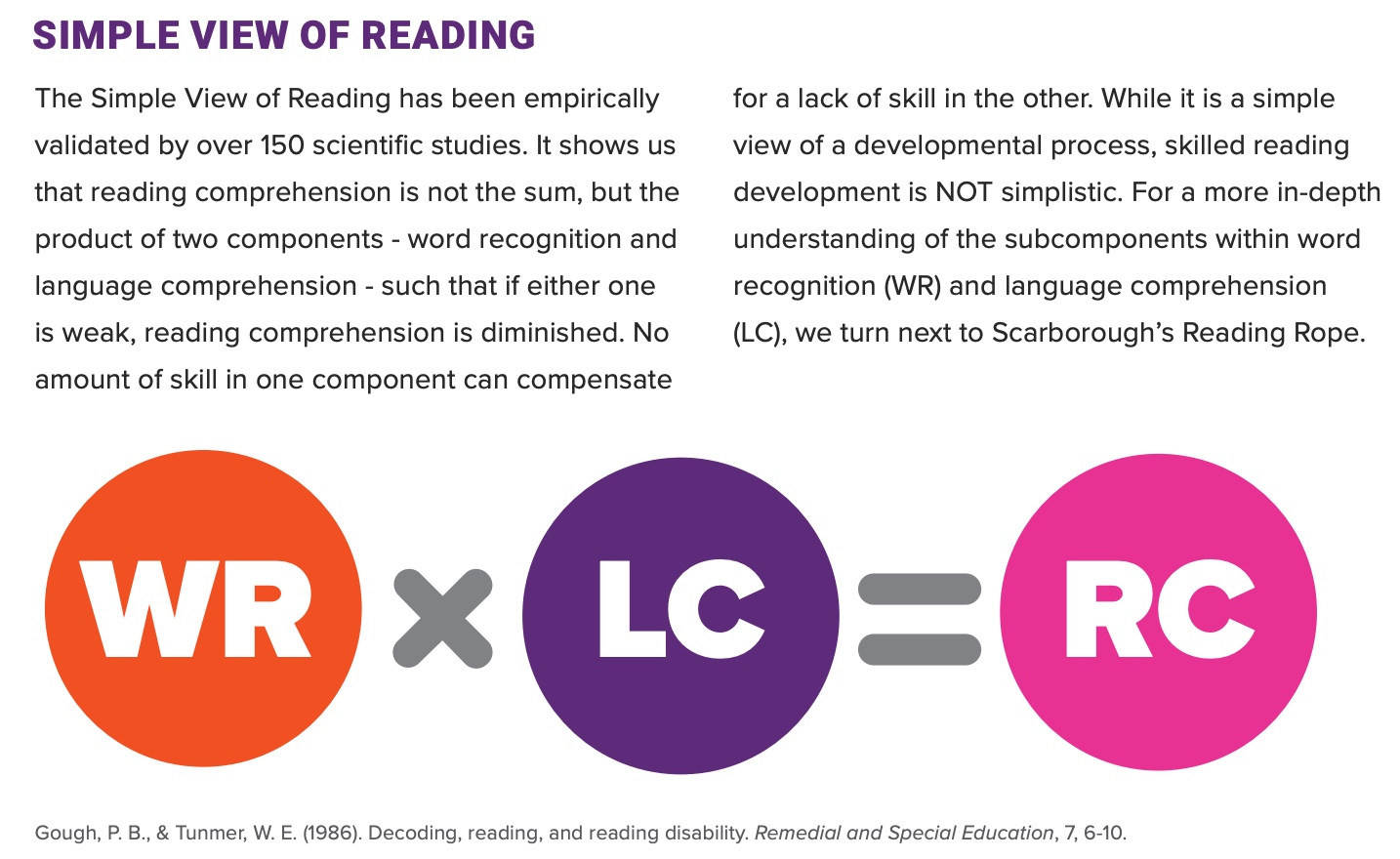
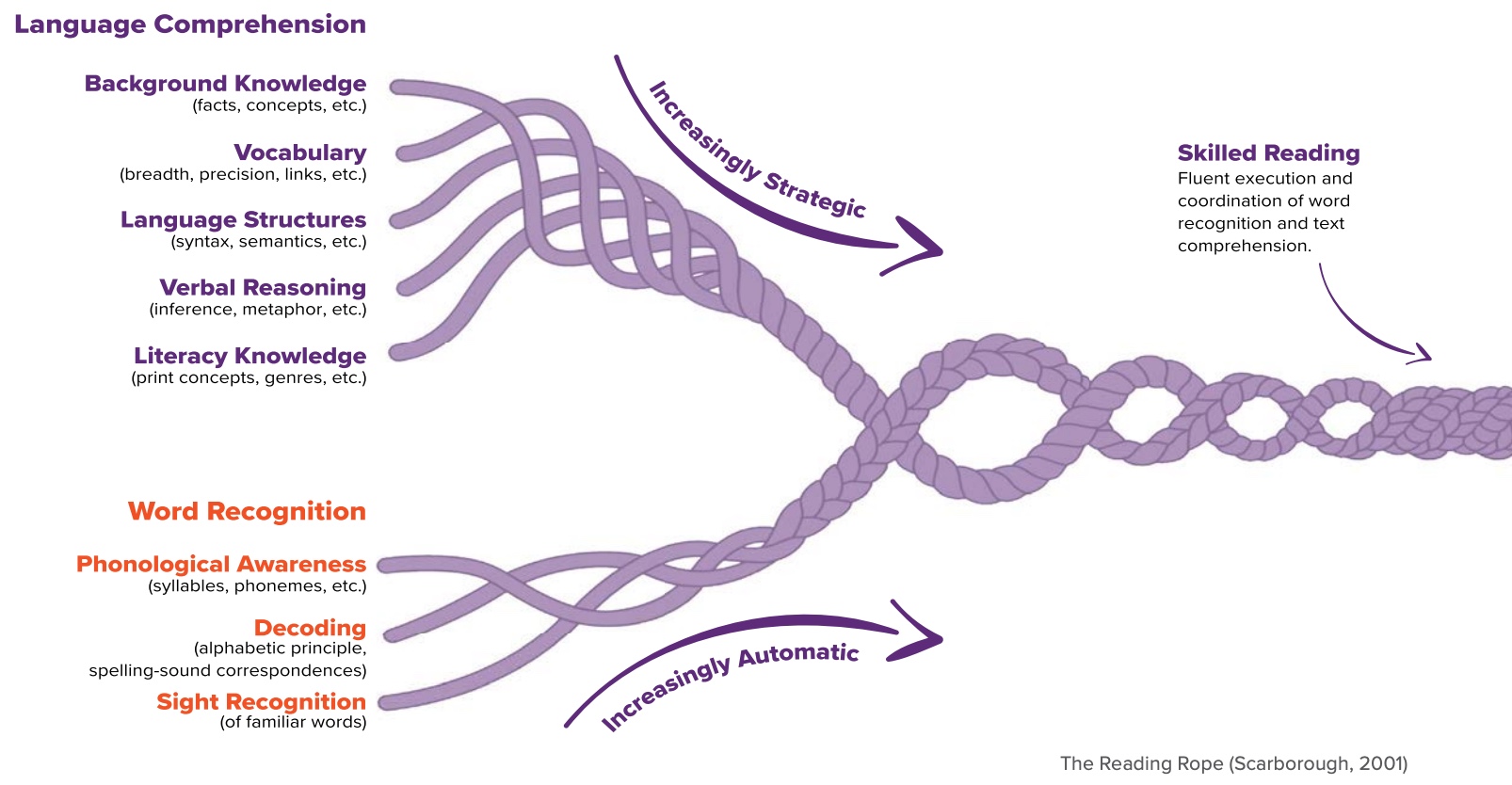
To help illustrate the research behind this work, two well-known models guide how we think about reading development: the Simple View of Reading and the Reading Rope. These visuals show how different skills come together to support students as they grow into proficient readers.
Our New Curriculum
A Shift in our Instruction
To support this shift to structured literacy, we have adopted new, high-quality curriculum materials. These programs are designed to align with the Science of Reading and provide our teachers with the resources they need to deliver effective, evidence-based instruction.
Grades K-5: Core Knowledge Language Arts (CKLA). CKLA is a comprehensive program that focuses on both foundational skills (phonics, phonemic awareness) and knowledge-building. It systematically teaches students to decode words while simultaneously exposing them to rich content in science, history, and literature. This helps students develop the knowledge and vocabulary necessary for strong reading comprehension.
Grades 6-8: Amplify ELA. Amplify ELA continues the structured approach into middle school, building on foundational skills while focusing on complex reading, writing, and vocabulary development. This year, we have fully implemented Amplify ELA in Grade 6, and we are excited to have our 7th and 8th graders pilot the program this school year. This pilot will allow us to gather valuable feedback as we consider full adoption for all middle school grades.
We are confident that these changes will lead to improved literacy outcomes for all of our students.
Explicit Instruction: We will directly teach reading skills. This is particularly crucial for foundational skills like phonics.
Systematic & Cumulative: Skills are taught in a logical, step-by-step sequence, building upon what has already been learned. This ensures a strong foundation before moving to more complex concepts.
Decodable Text: Students, in the early grades, will use texts that align with the specific phonetic skills they are learning. This allows them to apply their knowledge of letter sounds to read words, building confidence and automaticity.
Building Background Knowledge: A critical, but often overlooked, part of reading comprehension is having a broad vocabulary and understanding of the world. We are placing a greater emphasis on building knowledge across subjects.
Oral Language & Vocabulary: Strong speaking and listening skills are the bedrock of reading comprehension. We will be intentionally growing our students' vocabulary and their ability to express themselves verbally.
GLPS is Partnering with The Reading League
As we launch Amplify CKLA in grades K–8 as our core literacy curriculum, GLPS is partnering with The Reading League to provide ongoing professional learning for instructional staff. This partnership supports our shift to a Science of Reading–aligned structured literacy model.
The Reading League is a national nonprofit organization dedicated to advancing the Science of Reading—the body of research that explains how children best learn to read. They work with schools and districts across the country to deliver high-quality training, resources, and support for educators. By working with The Reading League, GLPS is ensuring that our staff has access to the latest research-based practices so that every student receives strong, effective literacy instruction.
Throughout the school year, The Reading League will lead breakout sessions during district professional learning days, including: Essentials of Phonemic Awareness (K–2), Essentials of Fluency Instruction & Assessment (3–6), Essentials of Phonic Knowledge (K–6), Remediating Gaps in Word Recognition (K–2), and Advanced Word Study (3–6). In addition, district and building leaders will take part in coaching sessions to help sustain and strengthen this work.
To kick off this approach, all preK–8 instructional staff (teachers, TAs/paras, and administrators—excluding math and specials) participated in a Teacher Introduction session with The Reading League. This session clarified what is meant by the Science of Reading and examined the gap between research and classroom practice. Educators explored three key anchors that guide evidence-aligned decisions in assessment, instructional materials, lesson planning, and evaluation, while reflecting on the critical role teachers play in leading this transformation.
Thank you for partnering with us in this important work. If you have any questions or would like to learn more, please feel free to reach out. I welcome your thoughts and feedback as we continue this journey together.
Dr. Bill Albrecht
Executive Director of Curriculum, Instruction, & Assessment
Grand Ledge Public Schools
albrechtw@glcomets.net

Structured Literacy Journey – Update, Jan. 2026
Additional Resources
- Comprehensive Health Advisory Team (CHAT)
- CHAT also serves as the district's Sex Education Advisory Board (SEAB) and the district's Wellness Committee.
- There are currently no vacancies on CHAT, but when there are, a link to apply will be placed here.
- Constitution Day teaching resources
- Student Handbooks